How uniqueness is decided
By default nfty guarantees that no two assets in a Set are the same. This page explains what "the same" means, how the unique DNA figure is counted, and how to switch the guarantee off.
An asset's fingerprint
Every asset gets a DNA: a SHA-256 hash of
- the Recipe it was rolled from,
- the Variant picked on each layer that is present, and
- for Dynamic and Static layers, the color that layer ended up with, quantized (below).
A layer left out by its absent chance contributes nothing, so two assets that both skip it agree about it. Paint order and depth never enter the hash. When a roll produces a DNA the Set already has, nfty throws the roll away and rolls again.
Colors are counted in buckets
A hue is a continuous number, so strictly every roll would be a new color and every asset trivially unique. That would be a worthless guarantee: two assets one degree of hue apart look identical.
So each colored layer's color is quantized before it reaches the DNA. The layer's QUANTIZE setting says how coarsely: a hue step of 30 divides the wheel into 30-degree buckets, and two rolls in one bucket count as the same color. Coarser steps mean fewer, more distinct colors; finer steps mean more.
The count is a promise
UNIQUE DNA on the CookBook panel (and the last line of nfty stats) is the number of legal,
distinguishable assets the book can produce: every variant combination the rules allow, times the
color buckets each colored layer can land in, with each optional layer adding its "absent" case.
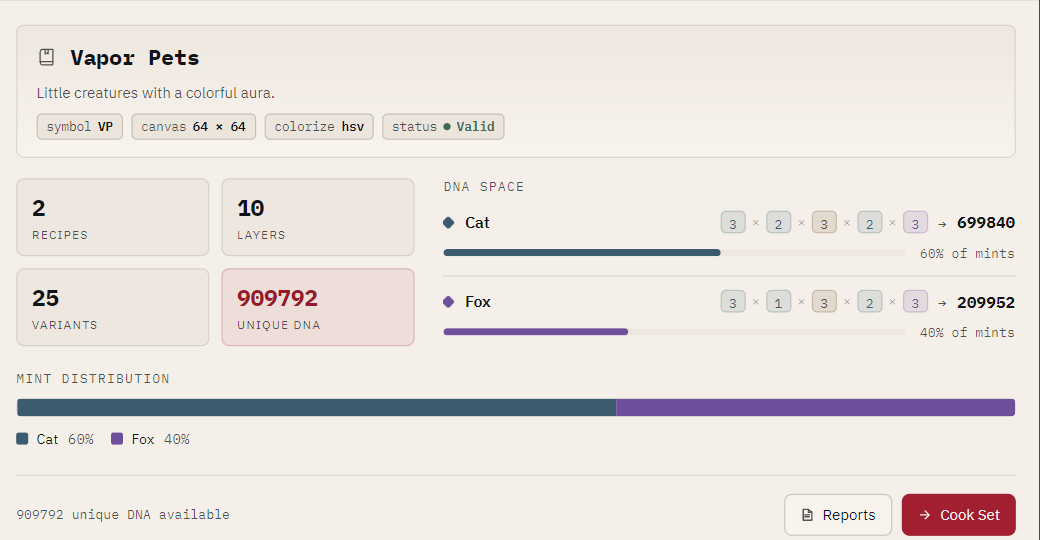
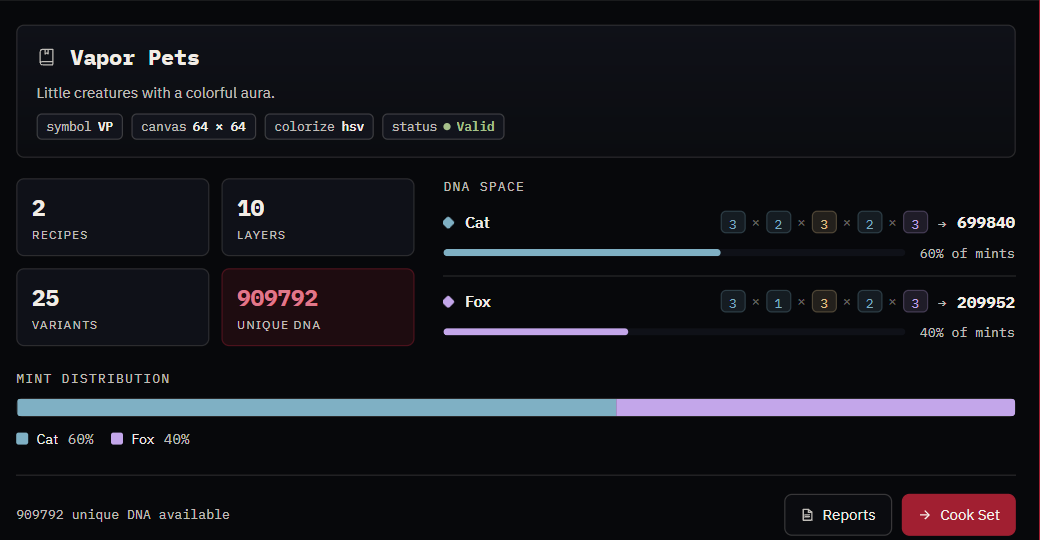
The DNA SPACE list shows the figure per Recipe, so you can see which one is the bottleneck. Ask for more assets than the total and nfty refuses before it starts and states the true maximum. It never ships duplicates you did not ask for.
When the figure is a bound, not a count
Nearly every book counts exactly. A few can only be bounded, and the wording says which direction:
| Wording | Means |
|---|---|
7,155,000 |
Exact. |
more than N |
A floor: a color set was too large to enumerate, so N under-counts. |
at most N |
A ceiling: a ruled Recipe has too many combinations to walk, so N is the count before rules removed any. |
cannot be counted |
Both happened (the figure bounds the truth in neither direction), or the book has problems; run nfty validate. |
Large figures print in full when they fit, then as a named magnitude (2.46 billion), then with an
exponent (2.18e21). The exact digits are on the figure's tooltip.
Two different failures
They look alike and mean opposite things:
- "...allows exactly N unique DNA, but M were requested." The space is real and smaller than what you asked for. Make it bigger: see Cooking.
- A rule conflict. The rules exclude every combination, so the space is empty. Remove or loosen a rule.
Allowing repeats
The guarantee has a cost: a small book cannot mint a large collection. Many collections are minted
the other way. Tick Allow repeats in the Cook dialog (or pass --unlimited) and every roll is
kept, so any count is producible from any book.
Nothing else changes. Rules are still enforced, and the weights still decide how rare each asset is: a low-weight variant stays uncommon, and a low-weight variant on a rarely present layer is rarer still. You give up only the promise that two assets are never identical. Identity becomes the asset's number, as ERC-721 defines it.
set.json records which mode made a Set ("uniqueDna": true or false). The same book and seed
give different collections in the two modes, because rejecting a duplicate consumes a roll the
other mode never spends. The seed and this field together reproduce a run.