How uniqueness is decided
By default, nfty guarantees that no two assets in a Set are the same. This page is what that guarantee actually means -- and how to switch it off, which is a normal thing to want.
An asset's fingerprint
Every asset gets a DNA -- a hash computed from:
- which Recipe it was rolled from
- which Variant was picked on each layer
- for Dynamic and Static layers, the color that layer ended up with
Two assets with the same DNA are the same asset, so when a roll produces a DNA that already exists, nfty throws it away and rolls again.
Colors are counted in buckets
A hue is a continuous number, so strictly speaking every roll produces a new color and every asset would be trivially unique. That would be a worthless guarantee -- two assets one degree of hue apart are the same asset to anyone looking at them.
So a layer's color is quantized before it reaches the fingerprint. The QUANTIZE setting says how coarsely: a hue quantize of 30 divides the wheel into 30-degree buckets, and two rolls in the same bucket count as the same color.
That is what makes uniqueness mean something. It is also the dial you turn when you need more of it -- see Raise the unique-asset count.
The count is a promise
UNIQUE DNA on the CookBook panel is not an estimate. It is the number of legal, distinguishable assets the book can produce: every combination of variants that the rules allow, multiplied by the color buckets each layer can land in.
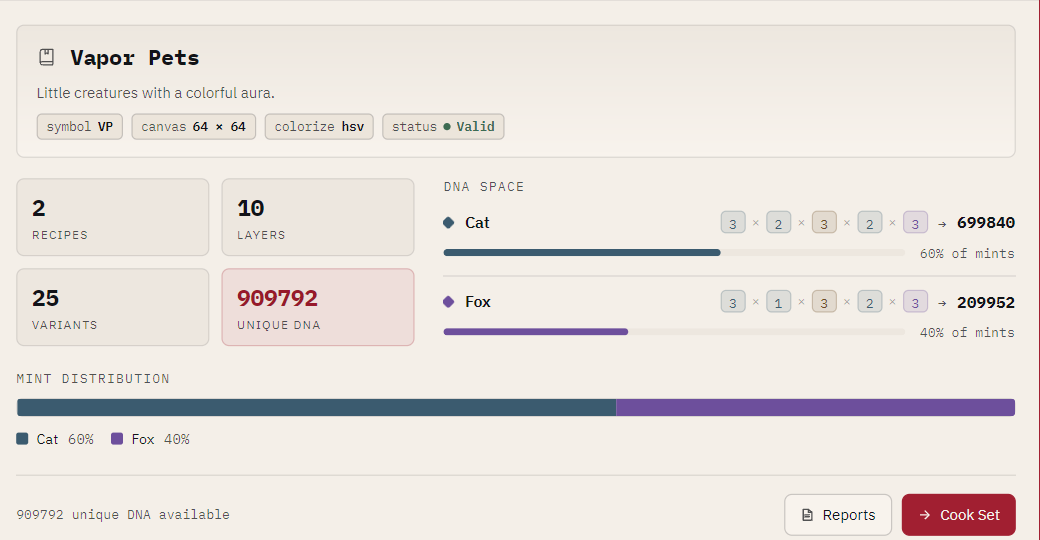
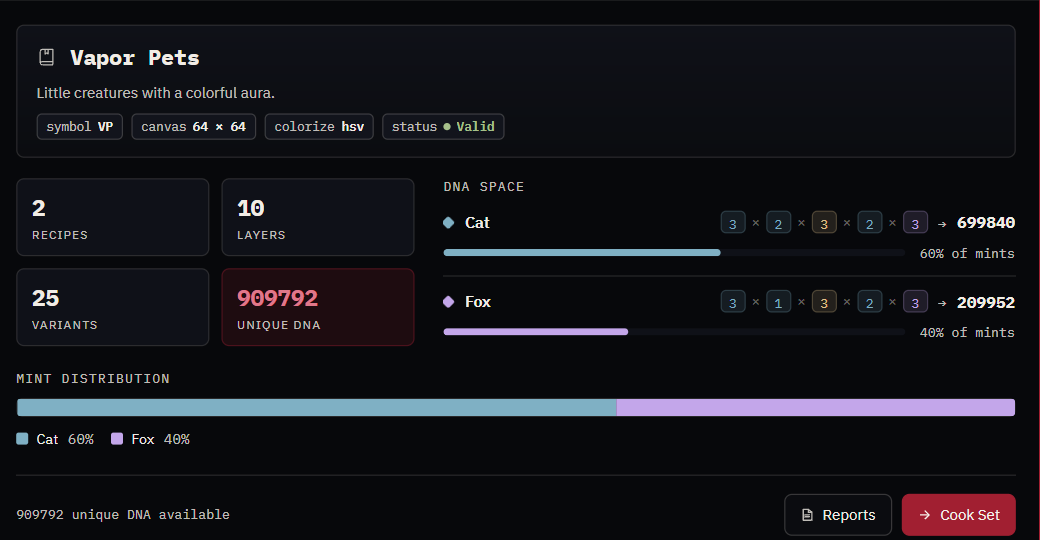
The DNA SPACE list shows the arithmetic per Recipe, so you can see which layer is the bottleneck.
Ask for more assets than that number and nfty refuses before it starts, and tells you the true maximum. It will not quietly ship duplicates.
Two different failures
They look similar and mean opposite things:
- "allows exactly N unique assets, but M were requested" -- the space is real, you asked for more than exists. Make the space bigger.
- a rule conflict -- the rules exclude every combination, so the space is empty. Remove or loosen a rule.
Very large books
Above about a million unconstrained combinations, nfty stops enumerating and reports "more than N" instead of an exact figure. The guarantee is unchanged; only the display is approximate, and a book that big is not going to run out.
Or don't require it
The guarantee costs something: a book can only produce as many assets as it has distinct combinations, so a small book cannot mint a large collection.
Plenty of collections are minted the other way. Tick Allow repeats in the Cook dialog (or pass
--unlimited on the command line) and every roll is kept, whether or not its fingerprint has come up
before. Any count becomes producible from any book.
Nothing else changes. The incompatibility rules are still enforced, and -- this is the part that matters -- the weights still decide how rare each asset is. A variant with a low weight stays proportionally uncommon; a layer with a low appearance chance is rarer still; and the rarest thing in the collection is the low-weight variant of a low-chance layer, which is exactly what a chase item is for. What you give up is the promise that two assets are never identical, not the rarity structure underneath.
Identity in that mode is the asset's number, the way ERC-721 defines it -- token 41 and token 402 are different tokens even if they look the same.
A Set records which way it was made, in set.json:
That matters more than it looks. The same book and the same seed produce a different collection depending on the setting, because rejecting a duplicate consumes a roll that the other mode never spends. The seed alone does not reproduce a run; the seed and this field together do.