Raise the unique-asset count
UNIQUE DNA on the CookBook panel is how many genuinely distinct assets the book can produce. Ask for more than that and nfty refuses, and tells you the real maximum, rather than shipping duplicates you did not ask for.
Four ways to raise it, cheapest first -- and a fifth option at the end, which is to stop needing it.
1. Widen a hue range
On a Dynamic layer, open the editor and drag the HUE RANGE handles apart:
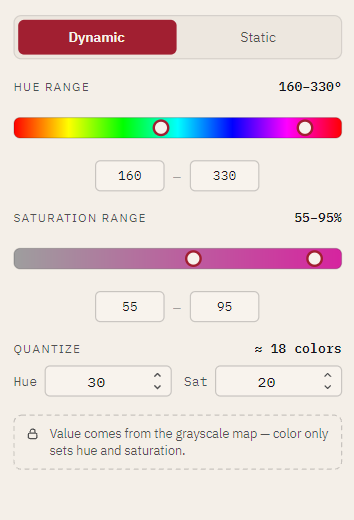
A wider range means more distinguishable colors, and the count is multiplied by them. This costs no drawing at all.
2. Make the quantize steps finer
QUANTIZE decides how finely nfty divides that range into colors it treats as different. The approximate-colors readout beside it shows how many the current settings admit.
Smaller quantize numbers mean finer steps, and more distinct colors.
3. Add a variant
One more option on a layer multiplies the whole combination count. This is the expensive one -- it means drawing -- but it is also the one that makes the collection look bigger rather than merely count bigger.
4. Loosen a rule
Every exclusion rule removes combinations. If a book is short by a little, a rule you added early and no longer need may be the reason.
Widening colors and adding art are not the same win
Color range multiplies the count. Variants multiply the visible variety. A book with two drawings and a huge hue range can produce a million distinct assets that all look like the same two drawings. Push both.
Or: allow repeats instead
None of the above is compulsory. If what you want is a large collection from a small book -- which is how a great many collections are minted -- tick Allow repeats in the Cook dialog and the limit stops applying: every roll is kept, and any count is producible.
You keep the rarity. The weights still decide how common each variant is, and a layer with a low appearance chance is still rare. What you give up is the guarantee that no two assets are identical.
See How uniqueness is decided for what that trade actually costs.